If you have started researching dental implants, you have probably noticed something confusing: the prices can be dramatically different from one dental practice to another. One dentist may quote a few thousand dollars while another recommends a treatment plan that costs considerably more.
So why are there so many prices for dental implants?
The answer is that you are not always comparing the same treatment.
A dental implant is not a single product with a single price. It is a complete process that can involve diagnosis, imaging, treatment planning, surgery, implant components, a custom restoration, laboratory work, and follow-up care.
Differences in any of those areas can affect the final cost.
And when you are comparing implant treatment, understanding those differences is much more useful than simply looking for the lowest number.
A Dental Implant Is More Than the Implant
One of the biggest sources of confusion is the term “dental implant.”
When most people hear that phrase, they picture the tooth that will eventually fill the space in their smile. But the implant itself is actually only one part of the treatment.
A typical implant restoration may involve:
- An examination and comprehensive treatment plan
- Digital or 3D imaging
- Tooth extraction, when necessary
- Bone grafting, when necessary
- Placement of the dental implant
- The implant components
- An abutment
- A custom crown or other final restoration
- Laboratory work
- Follow-up appointments and maintenance
Not every patient needs every step.
That is why two people can receive very different implant estimates—and why two prices may not represent two versions of the exact same treatment.
Why Can Two Dental Implant Prices Be So Different?
1. Every Patient’s Case Is Different
Replacing a recently lost tooth in an otherwise healthy mouth may be relatively straightforward.
Another patient may have been missing a tooth for years and have experienced bone loss. Someone else may need an extraction, bone grafting, treatment for gum disease, or other preparation before an implant can be placed.
The more complex the case, the more involved the treatment may become.
A meaningful implant estimate should account for the patient’s individual anatomy, oral health, and treatment needs rather than assuming every missing tooth can be treated the same way.
2. Treatment Planning Matters
Implant dentistry starts long before the implant is placed.
Your dentist needs to evaluate the available bone, surrounding teeth and tissues, bite, anatomy, and the position of the eventual restoration.
Three-dimensional imaging and digital treatment planning can help the dental team determine how the implant should be positioned and how that position will support the final tooth.
The goal is not simply to put an implant where a tooth is missing.
The goal is to plan the entire result.
3. The Experience of the Provider Matters
Implant dentistry involves both surgical and restorative considerations.
The person placing the implant needs to understand how the position, angle, depth, and surrounding anatomy can affect the final restoration.
Experience matters because no two patients are exactly alike.
A provider should be able to evaluate the variables in your particular case and explain why a specific treatment plan is being recommended.
4. Not All Implant Components Are the Same
The implant is a medical device, and there are different implant systems and components available.
The implant itself is only one part of the final restoration. The abutment and other components connect the implant to the visible tooth.
When comparing treatment costs, it is reasonable to ask:
What implant system and components are being used, and why?
You do not necessarily need to know every technical detail.
But you should be able to understand what you are paying for.
5. The Final Tooth Matters, Too
This is an important distinction that many patients do not realize:
The implant is not the tooth you see when you smile.
The implant serves as the foundation. The crown is the visible restoration that replaces the missing tooth.
That restoration needs to be designed with your appearance, bite, function, and long-term needs in mind.
A dental implant should not simply fill a space.
The finished result should feel like it belongs there.
What Does a Dental Implant Price Actually Include?
This is one of the most important questions to ask when comparing dentists.
If one practice advertises an implant for a certain price and another provides a significantly higher estimate, find out what each price includes.
Ask whether the quoted price includes:
- The consultation
- Diagnostic imaging
- 3D imaging, if needed
- Tooth extraction
- Bone grafting
- Implant placement
- The implant itself
- The abutment
- The final crown
- Laboratory fees
- Follow-up appointments
- Additional treatment if complications arise
A lower advertised price may be perfectly legitimate.
But if it represents only one part of the overall treatment, it is not necessarily a lower price for the complete procedure.
You need to know what you are comparing.
The Cheapest Dental Implant Is Not Always the Most Affordable
There is a reason people love finding a bargain.
Buying the budget option feels great—until the first time you understand why it was so cheap.
Dental implants are no different.
Price should absolutely be part of your decision. But when you are replacing a missing tooth, it is worth thinking beyond the initial number.
You are not simply buying a piece of titanium.
You are investing in a treatment that you hope will allow you to eat, smile, speak, and live normally for many years.
That makes questions about quality, planning, materials, experience, and follow-up care important.
The goal is not to find the most expensive dental implant.
The goal is to understand what you are getting for the price you are paying.
Check out this patient who came to Dr. White after trying a quick fix elsewhere
What Does “Quality” Mean in Dental Implant Treatment?
“Quality” is one of those words that every healthcare provider can use.
The more important question is:
What does quality actually mean for the patient?
For dental implants, we believe it comes down to three things.
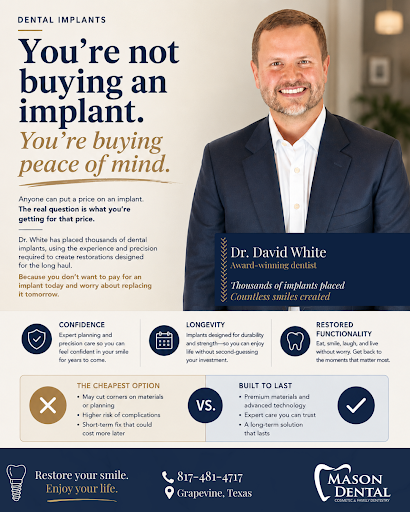
Confidence
You should understand your treatment plan and feel confident about the care you are receiving.
That means having your questions answered, knowing why a particular treatment is being recommended, and understanding what to expect.
Longevity
The goal should not simply be to replace a missing tooth as quickly as possible.
Treatment should be planned with the future in mind.
That means considering the health of the surrounding bone and tissues, the patient’s bite, the quality of the components, and the design of the final restoration.
Function
A missing tooth affects more than appearance.
It can affect how you chew, speak, smile, and interact with other people.
A successful restoration should allow you to stop thinking about the missing tooth and get back to living normally.
Eat. Smile. Laugh. Live.
That is the outcome that matters.
Questions to Ask Before Choosing a Dental Implant Dentist
If you are comparing dental implant providers, you do not have to be an expert in implant dentistry.
You just need to ask good questions.
Who will place my implant?
Ask who is performing the surgical portion of your treatment and about their experience with implant placement.
What implant system are you using?
Your dentist should be able to explain which system is being recommended and why it is appropriate for your situation.
What does the quoted price include?
Ask specifically whether the price includes the implant, abutment, crown, imaging, laboratory work, and follow-up care.
Will I need an extraction or bone graft?
Some patients need additional treatment before an implant can be placed. Make sure you understand whether those procedures are part of your treatment plan.
Who will make the final restoration?
The implant and the visible tooth are separate components. Ask how the final crown will be designed and fabricated.
What is the long-term plan?
This may be the most important question.
You are not just replacing a missing tooth today.
You are investing in how that part of your mouth will function for years to come.
Dental Implants in Grapevine, Texas
If you are considering dental implants in Grapevine, Colleyville, Southlake, or the surrounding North Texas communities, start with a conversation about your individual situation.
At Mason Dental, our approach is to help patients understand their options before making a decision. We take the time to evaluate your needs, explain the recommended treatment, and discuss what is involved in creating a long-term solution.
See more on our Dental Implants page!
If you are considering replacing a missing tooth, we would be happy to help you understand whether a dental implant is right for you and what your treatment may involve.
Financing Dental Implant Treatment
Understanding the cost of dental implants is important, but so is understanding how you can make treatment fit your budget.
At Mason Dental, we offer financing options through Cherry and CareCredit to help patients spread the cost of treatment over time rather than making the entire investment upfront.
Financing can be particularly helpful when dental implant treatment involves multiple stages or additional procedures, such as an extraction or bone graft.
The important thing is to make the treatment decision based on what you need—not simply on what you can pay today.
If dental implants are the right solution for you, we can review your treatment plan and discuss available financing options so you can make an informed decision about how to move forward.
Frequently Asked Questions About Dental Implant Costs
How much do dental implants cost?
The cost of dental implants varies depending on the patient’s needs and the complexity of treatment. The total may include diagnostic imaging, treatment planning, implant placement, the implant and abutment, the final crown, laboratory work, and additional procedures such as extraction or bone grafting.
Why are dental implants so expensive?
Dental implants involve much more than placing an implant into the jaw. The overall treatment can include diagnosis, imaging, planning, surgery, implant components, a custom restoration, laboratory work, and follow-up care. The complexity of the case and the experience of the providers involved can also affect the cost.
Why do dentists charge different prices for dental implants?
Dental practices may have different pricing because they use different implant systems, provide different levels of planning and technology, include different services in their estimates, or treat cases with different levels of complexity. Comparing the total treatment plan is more useful than comparing a single advertised price.
Are cheap dental implants safe?
A lower price does not automatically mean that implant treatment is unsafe or poor quality. However, patients should understand exactly what is included in the quoted price, which components are being used, who is providing the treatment, and what follow-up care is included before making a decision.
What is included in the cost of a dental implant?
This varies by practice and by patient. A complete implant treatment may include an examination, imaging, treatment planning, implant placement, the implant and abutment, the final crown, laboratory work, and follow-up care. Additional procedures such as extraction or bone grafting may be necessary in some cases.
Are dental implants worth the cost?
For many patients, dental implants can be a valuable long-term investment because they can restore both function and appearance after tooth loss. Whether an implant is right for you depends on your oral health, treatment needs, goals, and individual circumstances.
How long do dental implants last?
Dental implants are designed to be a long-term tooth replacement solution, but their longevity depends on factors including oral hygiene, gum health, bone health, bite forces, lifestyle factors, and regular professional care. Your dentist can discuss the expected longevity of your specific treatment.
What should I look for when choosing a dental implant dentist?
Look for a provider who can clearly explain the treatment plan, what is included in the cost, which implant system and materials are being used, how the treatment is being planned, who will provide each stage of care, and what follow-up will look like. Dr. David White at Mason Dental has placed thousands of implants and has won multiple awards for his quality and reliability.